
I remember the moment vividly.
It was 9:46 p.m., and I was staring blankly at my laptop screen—Slack pings lighting up, pitch decks overdue, people with questions and an ever growing backlog of customer and investor requests unanswered. The office was dark. My dinner was cold. My family was fast asleep, again.
I was supposed to be leading. Instead, I was stuck in an endless cycle of reacting, not creating. Managing, not thinking. I wasn’t just tired—I was overwhelmed.
In front of me was a long list of undones; proposals, emails, and ideas I never had time to work on.
It was at that moment I realized something brutally simple: If I didn’t find a new way to work, I was going to burn out.
That night, I decided I was going to unlearn. I wrote out each task I was doing daily. What must I do, could offload and automate? I was desperate to claw back time, sanity, and some space to think clearly again.
What happened next changed everything.
That late evening I didn’t just let go of what was holding me back, I started creating an operating system and technology stack that would change the way I worked forever. I downloaded a meeting co-pilot, started uploading two meeting recordings to try to write up summaries, insights, actions and next steps to share with attendees.
What I got back wasn’t perfect—but it was a start, 60% of something better.
That one experiment sparked a shift: from feeling buried and behind, to starting each day with clarity and leverage.
From overwhelmed to optimized.
Since then, I’ve rebuilt how I work—using AI not to replace my judgment, but to protect it. To buy back time. To think strategically. To lead with intent.
To do real deep work again.
And this blog is your invitation to do the same.
Not to add more to your plate but to finally clear it. Not to share yet another list of “AI Productivity Tools”, but to build a real system for getting your time and mind back.
Let’s go.
Why Leaders Struggle With AI (and What We Learned From Asking You)
I’ve been using my system and technology stack almost 10 years ago now. Rev.com was my go-to tool for talking (not writing) Unlearn—you may have read my blog Unlearning To Write A Book about it.
I’m dyslexic so tools to aid communication, grammar, capture conversations over typing everything has always been top of mind for me. While Rev help me create a book, other tools like Otter.ai helped me focus on listening more, than taking notes in meetings.
Bit by bit I built up tasks I struggled with, and tools that helped address them, and experimented constantly to see what worked and what didn’t.
Today the tools explosion is taking over. Every hour a new one appears to change your life.
Now, that overwhelmed feeling for leaders isn’t only the work they have to do, it’s the FOMO of wondering what they might be missing out on, and if the promise of AI Productivity is real?
Recently, we surveyed over 5,000 leaders exploring or using AI. The results were revealing:
- 72% said their biggest blocker was not knowing where to start
- 61% admitted they don’t have a clear AI strategy, even though they believe it’s essential.
- 46% feared “wasting time” on tools without a clear ROI.
- However, 92% believed AI could significantly boost personal productivity if used correctly.
These aren’t technical hurdles—they’re strategic and behavioral ones.
And that’s the crux of the issue: AI is not a tool problem. It’s a leadership opportunity.

If you want the full breakdown, start by completing the survey here.
Principles for Optimizing Personal Productivity with AI
If you’re looking for hacks, scroll TikTok.
If you’re looking to lead with leverage, keep reading.
Here are the principles I now live by—and teach others in our cohort programs—to consistently get 5x–10x returns on my time using a system of work leveraged with AI.
1. Stop Starting with Tools. Start with Tasks.
Don’t ask “Which AI should I use?”
Ask: What am I doing repeatedly, manually, or mindlessly that a machine could handle?
Start small. Think:
- Summarizing meetings or documents.
- Creating first drafts of emails, decks, or blog posts.
- Categorizing data or extracting insights.
One leader in our cohort used ChatGPT to summarize weekly team updates. Time saved: 3 hours/week. That’s 150 hours a year—nearly an entire month reclaimed.
2. Treat AI Like a Junior Analyst, Not a Magic Wand
Expecting perfection out of the gate is a setup for disappointment.
Instead, treat AI as a capable but junior team member:
- Give clear instructions.
- Expect to invest time building context, knowledge and style.
- Know you’ll still need to edit.
AI won’t replace your thinking—but it will accelerate it. Think of it as the first bad draft of everything—at lightning speed. Then you iterate to improve.
3. Design Before You Automate
The fastest way to waste time with AI? Automate chaos.
Before building automations or workflows, take time to design your strategy:
- What’s the outcome you want?
- What decisions do you still need to make?
- Where is human judgment essential?
One of our coachees spent weeks automating outbound sales emails—without a positioning strategy. The result? Fast output, zero results. Don’t confuse activity with impact.
4. Velocity is a Strategy—When Paired With Clarity
AI gives you velocity: faster drafts, more iterations, greater throughput.
But speed alone is dangerous. You need direction.
In our cohort, we often say: Strategy is a compass; AI is the engine.
Want to publish more content? Great. But what do you want that content to do? Get clear on the outcome, understand the human inputs, then let AI help you scale the output.
ROI You Can Feel: Time, Speed, and Volume Gains
Let’s break down real-world examples we’ve seen across our training programs:
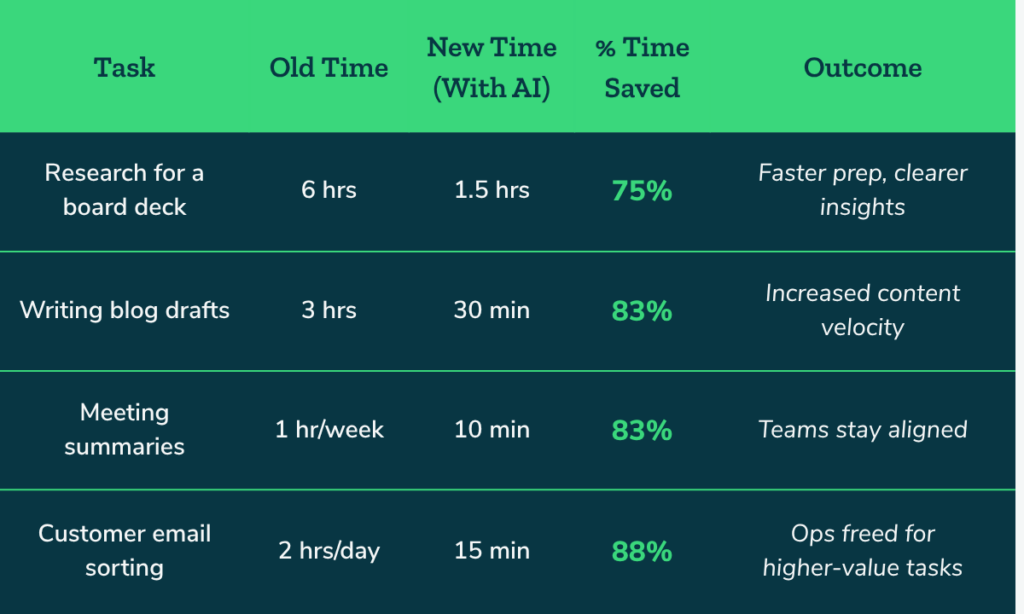
It’s not just time—it’s trajectory. That 5–10 hours a week compounds into better decisions, faster iterations, and space to lead.
But Don’t Be Fooled: Tactics ≠ Strategy
Here’s the truth few say out loud: most people get stuck playing with AI tools.
Why? Because it’s fun. It’s dopamine.
But tools alone won’t transform your leadership. They just amplify what’s already there—good or bad.
That’s why we push (and coach) leaders to shift from:
- Playing with prompts → Designing workflows
- Automating tasks → Architecting outcomes
- Using AI alone → Integrating AI across teams
The tool is the tactic. The outcome is the strategy.
So, What’s Next for You?
The opportunity is massive—but so is the noise.
If you’re serious about integrating AI into your leadership practice, not just your inbox, here’s where to start:
Task out your time sinks. Think about where to leverage human insight and artificial intelligence
Try out our free tools on:
→ Personal AI assessment of where you’re at
→ How to create an AI strategy with this worksheet
→ Create your AI tool stack for improved productivity
Or even better, join one of our cohort programs!
We run live, hands-on sessions with other founders, execs, and operators like you.
You’ll walk away with:
- A clear productivity strategy for your role.
- Custom workflows tailored to your work.
- Confidence in your AI decisions.
And you’ll join a growing network of leaders turning AI anxiety into strategic advantage.
Final Word: Your Calendar Reflects Your Leadership
AI doesn’t change who you are. It amplifies it.
If your calendar is full of reactive, low-leverage work, AI will make you better at being overwhelmed.
If your calendar has space to think, design, and decide—AI will multiply your impact.
The question isn’t whether AI will change your productivity.
The question is: Will you lead that change, or let it lead you?
FAQ
Q1: Why do leaders struggle with AI?
Leaders often struggle with AI not because of technology but because of strategic and behavioral challenges. Many are unsure where to start, lack a clear AI plan, or fear wasting time experimenting with tools that do not deliver meaningful results. Even though most leaders believe AI can improve personal productivity, they hesitate because they do not have a clear path or workflow for using it effectively.
Q2: What should leaders focus on first when using AI for productivity?
The blog emphasizes starting with tasks, not tools. Instead of asking which tool to use, leaders should identify repetitive, manual, or low-value tasks that consume time. Tasks like summarizing meetings, drafting communications, or categorizing information are ideal starting points. This approach helps leaders create quick wins and build confidence in their AI workflow.
Q3: How should leaders think about AI in their daily work?
Leaders are advised to treat AI like a junior analyst. It can produce fast drafts, help process information, and speed up execution, but it still requires guidance, clear instructions, and human judgment. When leaders provide context and refine the output, AI becomes a reliable support system that boosts overall productivity.
Q4: What is the next step for leaders who want to integrate AI into their workflow?
Leaders should review where their time goes and identify opportunities to leverage AI for insight, clarity, and efficiency. The blog suggests using tools like AI assessments, strategy worksheets, and task-mapping exercises to build a more intentional system. Joining a cohort or structured program can help leaders gain tailored workflows and learn from others facing similar challenges.
Q5: Will you lead the AI change, or let it lead you?
The blog concludes with a powerful question. AI does not change who you are as a leader. It amplifies your habits and priorities. If your schedule is packed with low-leverage tasks, AI will reinforce that pattern. If you create space for strategic work, AI will multiply your impact. The choice is whether you use AI intentionally or allow it to shape your day without direction.
References
- Newport, C. (2016). Deep Work: Rules for Focused Success in a Distracted World. Grand Central Publishing.
- Susskind, R., & Susskind, D. (2015). The Future of the Professions: How Technology Will Transform the Work of Human Experts. Oxford University Press.
- O’Reilly, B. (2019). Unlearn: Let Go of Past Success to Achieve Extraordinary Results. McGraw-Hill Education.
- O’Reilly, B. (2019). Unlearning to Write a Book. Barry O’Reilly Blog.
- O’Reilly, B. (2025). Executive AI Diagnostic Assessment.
- O’Reilly, B. (2025). AI Strategy Worksheet. Barry O’Reilly Resources.
- O’Reilly, B. (2025). AI Tool Stack Resources for Improved Productivity. Barry O’Reilly Resources.